
How Baumann Consulting structures enclosure commissioning in CxAlloy, from phased testing to the trades in the field.
Building enclosure commissioning (BECx) is commissioning, but it does not run like MEP commissioning. Testing is phased across construction, not concentrated at the end. Scope grows with the installed work. And the information the commissioning provider depends on sits with subcontractors and manufacturers it has no contract with.
Commissioning software has generally been tailored to MEP work, where a fan coil unit or an air handler is a discrete, numbered piece of equipment. An air barrier is not. So the question for enclosure teams is practical: how do you organize a commissioning platform around the way enclosure work actually happens?
John David Wagner, AIA, BECxP, a Senior Building Enclosure Consultant who leads the Building Enclosure Performance team at Baumann Consulting, and Jacob Terry, Director of Product Development at CxAlloy, took on that question at CxEnergy 2026. This article draws on that session. The framework and field lessons come from Baumann Consulting’s practice, the platform mechanics describe how CxAlloy is structured, and the case studies are Baumann projects.
What building enclosure commissioning is
BECx is a process that ensures the exterior enclosure system performs consistently with the Owner’s Project Requirements and the design specifications. Through design review, construction observation, mock-up and field testing, and documentation, it provides enhanced quality assurance toward the project’s goals for energy, durability, and occupant comfort, throughout the life of the building.
The stakes are long-term. Enclosure performance affects a building’s energy consumption over its lifetime and carries significant maintenance and operating cost. A modest investment at the start of a project gives the owner assurance that what was specified and designed performs as expected.
The comprehensive process
The full-scope approach follows ASTM E2947 and tracks the same arc as MEP commissioning, from pre-design through occupancy and warranty:
- Define. Set enclosure performance expectations as early as possible, while they can still influence the design.
- Review. Check how the design fulfills those expectations.
- Conform. Through bidding and negotiation, help the owner and project budget conform to the testing expectations.
- Verify. During construction, witness and confirm the performance tests on the enclosure elements called out in the specifications.
- Report. Document what happened on the project for the owner and, where required, the authority having jurisdiction.
A continuum of service
BECx is not one fixed scope. Wagner frames the level of service as a continuum: advisory, participatory, oversight, and lifecycle. At the light end is work such as code air barrier verification and reporting to the authority having jurisdiction. At the full end is an ASTM E2947 scope, which can extend into a lifecycle relationship with the owner as maintenance, repairs, and failures come up over the life of the building. The contract sets where a project lands.
In Wagner’s experience, the service is also shifting. What was once a premium service is becoming more of a commodity, and smaller projects with smaller budgets now look to the BECx provider as the definitive source for performance expectations, code compliance verification, on-site testing, and reporting.
Three challenges that set BECx apart
From Baumann’s practice, Wagner groups the difficulty of delivering enclosure commissioning into three areas: team, time, and scope. Managing these three types of information across multi-year projects is the core challenge of BECx delivery, and in his view they make or break the profitability of a BECx project.
1. Team management
BECx complements the work of the owner, the architect of record, the general contractor or CM at risk, and subcontractors, facility managers, energy consultants, and developers. It also leans heavily on subcontractors and manufacturers during procurement. That is especially true with delegated design, such as curtain wall systems, where the manufacturer may need to show the system works through simulation and analysis and then build and test a physical mock-up in a laboratory.
Contractually, though, the BECx provider (BECxP) is typically hired by the owner or the architect. The provider needs a great deal of information from parties it has no direct contract with, so enforcing the process becomes an indirect contractual obligation of the project team. Chain of custody of information is a recurring theme.
Wagner places the BECxP at the center of three stakeholders, each with its own role and a shared responsibility with the others:
| Party | Role in BECx |
|---|---|
| Owner | Engage and support the BECx process at all phases; define operational and maintenance goals and budget |
| Architect | Design efficient enclosure systems; give design and submittal comments careful consideration |
| Contractor | Include testing and building enclosure milestones; set up the schedule to sequence work correctly and catch issues early |
| Owner and architect | Align on performance goals; support BECx on reviews and testing plans; resolve issues and constructability gaps |
| Owner and contractor | Support commissioning activities; communicate openly and on time about scope, schedule, and testing documentation; ensure work is code compliant |
| Architect and contractor | Take part in on-site walkthroughs; communicate design intent clearly and consistently in the drawings; review submittals and RFIs |
| BECxP | Qualified expert in enclosure design, construction, and performance; independent third party or part of the owner’s team with independent judgment; manages and executes BECx per the OPR, codes, and project specifications |
The project specifications frame these relationships, particularly Section 01 91 19, Building Enclosure Commissioning Requirements, which tells the contractor and subcontractors what participation is expected. Wagner also points to the Building Enclosure Commissioning Plan, the counterpart to the MEP commissioning plan. In his experience it is often not carried with the drawings and project manual in the field, yet it becomes the definitive reference when coordinating and adjudicating construction-phase testing and verification.
In the example section Wagner showed, the general contractor’s base bid responsibilities include assigning representatives to take part in commissioning activities, providing field quality control testing and inspections on the exterior enclosure (including completing commissioning checklists), directing subcontractors to correct deficiencies, coordinating with manufacturers on warranty requirements, and completing construction checklists as work is finished and providing them to the commissioning agent weekly.
2. Time management
BECx is lightly embedded in the project schedule, with touch points from pre-design well into construction. Within construction, the critical engagement falls in roughly the first 30 to 50 percent of the schedule.
Procurement drives this. Enclosure submittals happen well before products arrive on site, so the BECx team needs to know when the general contractor is procuring from its subcontractors, especially for long-lead items. That is the window to spot deviations from the specifications before they reach the field. MEP commissioning typically engages later, leaving more time between contract award and the commissioning kickoff.
The BECxP also generally follows the architect’s and contractor’s schedules rather than setting them. Revised schedules, delayed bids, and addenda all add coordination, meetings, and communication, and delays erode awareness of and engagement with BECx. The provider has to stay aware of the project’s status while being careful about how much budget each check-in consumes.
One project schedule Wagner shared shows how this plays out. The BECxP was hired in April 2025, after the 75% construction documents submittal. The 100% CD submittal then slipped from July 2025 to November 2025, and the prime bid moved from September 2025 to December 2025 and then to May 2026.
3. Scope management
BECx scope is usually set in the design phase and then renegotiated during construction mobilization, once market costs are known. Several pressures make it hard to contain:
- Access disappears. A unit heater stays accessible after finishes go in. Once a fluid-applied air barrier is covered with girts and exterior insulation, that layer can no longer be reached, and verifying it becomes prohibitively expensive. A whole-building blower door test promised for the end of the job is, in Wagner’s words, deferred liability. If it fails, the hard and soft costs of finding the failure point rise sharply.
- Submittal review volume. Review is often bid on a sampling basis, but in enclosure work every product data sheet matters. A missed mismatch in a window type’s specification or a storefront system’s design pressure can cause delays later in construction.
- Checklist timing. Construction checklists are meant to be completed by subcontractors, but they are often filled out after the product has arrived or been installed.
- Retests. Failed tests need retesting, and sometimes additional samples of the same system type, which the contractor’s critical path rarely accounts for.
With each of these, additional coordination meetings become more likely. The testing itself also usually depends on others: in Wagner’s description, BECx providers rely on subcontractors or general contractors to procure third-party testing services and fold them into the critical path.
From spreadsheets to a single source of truth
The conventional way to run commissioning administration is spreadsheets, email notifications, and calendar invitations. Terry described the problem with that approach from his own early experience in the field, which also shaped the origins of CxAlloy. A long day of on-site testing was followed by an evening of transcribing notes, downloading photos from a camera, renaming them, attaching them, and formatting a report. The information was captured once in the field and then entered again to produce the deliverable.
CxAlloy is built to remove that double entry. Information is recorded on site, it already lives in the system where it needs to be, and producing a report means generating it, not formatting it. A platform also gives the whole team a single source of truth and a high-level view of project status, which is difficult to get from spreadsheets and ad hoc email.
For BECx, where Wagner describes scope, time, and team as the variables that decide a project’s success, that visibility matters even more. The rest of this article shows how Baumann Consulting adapted CxAlloy’s core objects to track those variables.
Modeling enclosure scope as assets
How assets work in CxAlloy
In CxAlloy, “assets” covers more than equipment. There are eight entities under the assets umbrella. Equipment sits at the root, and each piece of equipment can be of an equipment type, located in a single space, and tied to one or more systems. Spaces sit on floors, floors in buildings, and buildings in campuses. Spaces can also belong to one or more zones.
Two of those relationships are many-to-many. A piece of equipment can belong to several systems, and a system contains many pieces of equipment. A space can belong to several zones, and a zone contains many spaces. The structure reflects how real facilities fit together, but it can also carry more abstract groupings. Terry’s example: a system called “Phase 1” that groups the equipment tied to a billing milestone, so the team knows when to invoice.
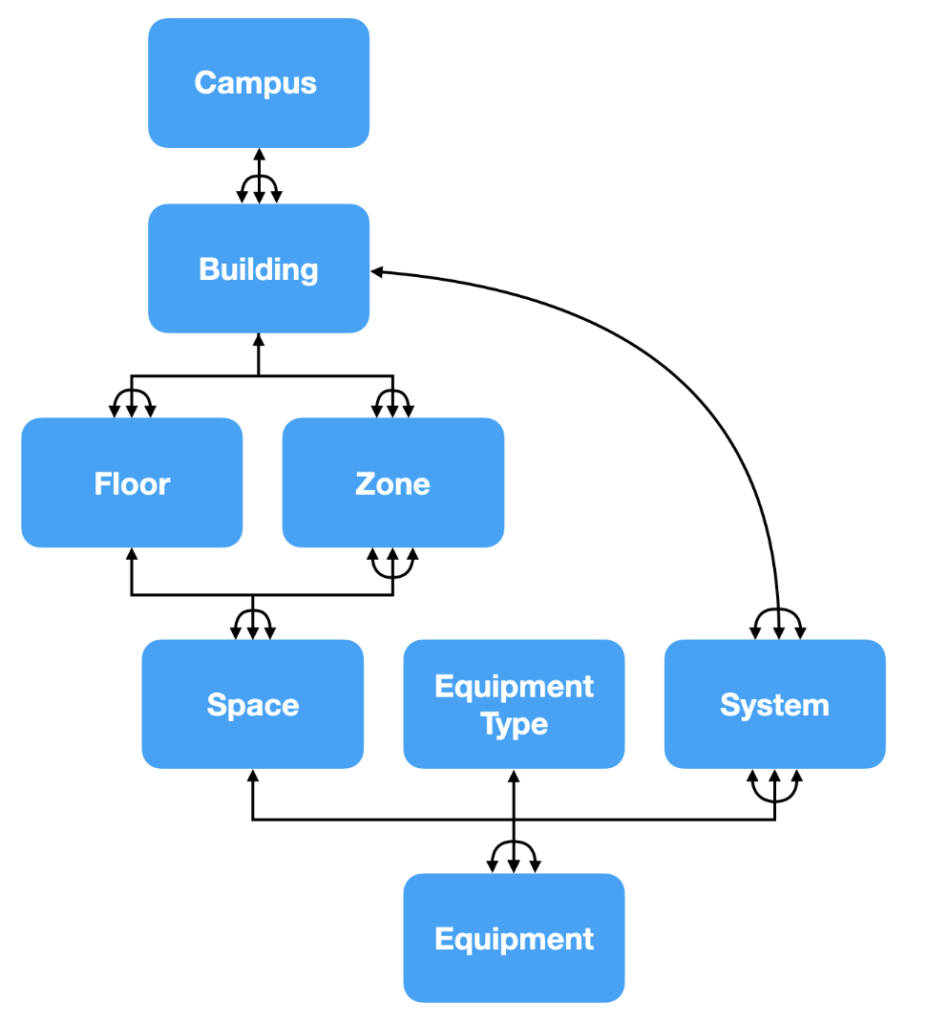
CxAlloy’s project structure brings together the project, its assets, and the work attached to them: reviews, checklists, issues, tests, and reports.
How Baumann maps BECx onto those objects
| CxAlloy asset category | How Baumann uses it for BECx |
|---|---|
| Equipment | The component in BECx scope |
| Equipment type | The division of that component |
| Systems | Assemblies, such as “Thermal and Moisture Protection” or simply “Wall Assemblies” |
| Locations | Where the equipment sits on the job, including buildings and campuses |
Of these, Baumann treats the division as the most important variable. Enclosures are designed as assemblies that draw on many parts from many divisions, but testing is specified by division. Because the contractors Baumann works with organize their specifications by CSI or MasterSpec division, Baumann organizes its tests by the division of the enclosure equipment in scope.
Testing is phased, and quantities scale with the work
MEP testing tends to happen at the end of a job. BECx testing happens at milestones during construction. Baumann’s practice reflects how enclosure testing is typically specified:
- Baseline set in design. BECx establishes planned testing intervals and baseline quantities during design.
- Typical intervals. Testing is typically specified at approximately 0% (pre-construction mock-up), 10%, 30%, 50%, 70%, and 100% of construction.
- Finite types, scaling quantities. Test types are categorically finite (air, water, adhesion, using standardized test methods), but quantities scale with the extent of installed work.
- Confirmed in construction. Final quantities and locations are confirmed once the general contractor and project team know the actual products, window types, and installation scope.
Wagner’s example is air barrier testing to ASTM E1186, which is typically written in sets of 25 tests and specified at several points during installation. He noted this can mean upwards of 75 locations to test on an air barrier that is not a finite object. There is no “air barrier 1, 2, 3.” There is simply the air barrier as installed at 10 percent of construction. That is very different from fan coil unit number 4.
This makes preconstruction coordination with the contractor essential. When will the air barrier go in, how much of it, and on what substrates? The testing framework is defined before construction, and the specification adapts to the realities of the job in the first few months.
Each test then has associated construction checklists and submittal reviews, and is referenced in meeting minutes and field observation reports. Preconstruction submittal reviews inform mock-up testing, pre-testing construction checklists get ahead of field testing, tests document the field testing, and follow-up tests handle any failures. The result is a critical path relationship between documentation, testing, and reporting.
Construction checklists carry real weight here. If a manufacturer requires primer for a sheet-applied transition membrane, at a sill flashing for example, and that step is skipped, every adhesion test that follows could fail. One missed step then costs time and money: hard costs to replace the product, and soft costs for the architect, owner, general contractor, and BECxP to sort out the issue. That is why Baumann tracks the checklists tied to each test and component actively, rather than simply assigning them.
Tagging equipment by construction stage
Because equipment is the object that every requirement attaches to, Baumann writes phased identifiers into equipment names. Each name combines three parts: the component with specified test requirements, the timeframe for fulfilling the test, and a readable designation of that timeframe. One storefront component becomes six equipment records:
- Aluminum-Framed Entrances and Storefronts-000%-Pre-Construction Mockup
- Aluminum-Framed Entrances and Storefronts-010%-Construction Progress
- Aluminum-Framed Entrances and Storefronts-030%-Construction Progress
- Aluminum-Framed Entrances and Storefronts-050%-Construction Progress
- Aluminum-Framed Entrances and Storefronts-070%-Construction Progress
- Aluminum-Framed Entrances and Storefronts-100%-Construction Progress
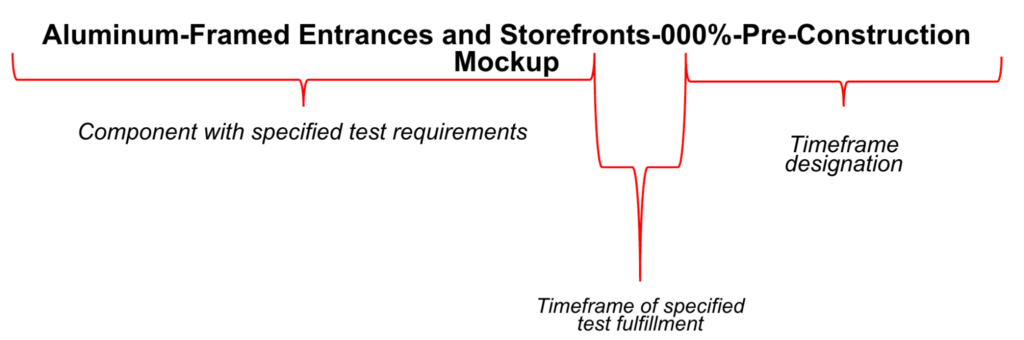
The tag tells everyone the construction stage at which the asset must be tested. In Baumann’s project records, each of these carries the equipment type “08 41 13 Aluminum-Framed Entrances and Storefronts,” the specification division. Each record hosts its own checklists, tests, and issues for that stage, so specification requirements are met by construction stage rather than tied only to the building element. When a test is due at 10 percent, the 10 percent record receives the test, the checklist, and any issue, and it becomes the point where the team confirms with the contractor that a fix is complete.
Open one of those records and you see its status at a glance. In one example Wagner showed, the equipment was marked installed, with three resolved issues, a checklist in progress, and four fulfilled tests. Without that, the team would spend billable time updating a spreadsheet that is not linked to anything else in the project.

The same logic applies to an air barrier. In one of Baumann’s projects, the record “Weather Barriers-000%-Preconstruction Mockup” sits under the equipment type “07 25 00 Weather Barriers” and the system “Thermal & Moisture Protection.” If Division 07 25 00 has requirements at the pre-construction mock-up, 50 percent, and 100 percent, Baumann creates three equipment records. The 0 percent record owns the submittal checklists, so nothing is installed until submittals are sorted out, along with the installer’s first construction checklist and the first test. The 50 and 100 percent records each carry their own checklists and tests. Where there is no test at a stage but the owner has a QA/QC policy, Baumann adds construction checklists at whatever interval suits the job.
Baumann does not split enclosure equipment by elevation or zone. The subcontractor decides how installation actually proceeds, and weather and sequencing change it day to day. What matters for tracking is the phase of construction for that division, so the team cares that the 10 percent test was fulfilled, whichever elevation it was on, unless the owner’s architect or enclosure consultant has specified otherwise. As Wagner put it, BECx is a dialogue with the contractor, and the tool is adapted to that conversation.
Two practical notes came out of this approach. First, a single division can have three or four contractors installing it, which multiplies the tests to track in parallel. Second, these names are long. Terry noted that CxAlloy’s early sample data used short tags like AHU-1, and customers quickly pushed well past that. Long names like these display correctly throughout CxAlloy, including in PDFs. Wagner added that Baumann tested long, descriptive names so subcontractors could understand what had been assigned to them without having to decode a systems tag.
Running the BECx workflow digitally
Around those tagged assets, Baumann uses CxAlloy’s standard commissioning features much as most commissioning teams would, with enclosure-specific adaptations.
Design reviews
Baumann uses Reviews to track design and construction reviews of the architect’s documents. Review issues are assigned to specific team members based on priority, and each one links to the exact detail it references. Wagner noted the lasting value of this: being able to pull up a detail review comment made two years earlier, in a meeting on the job site, can carry real weight when design decisions made in an office come into play in the field.
Checklists for submittals and installation
Baumann uses Checklists for two jobs: tracking submittals and tracking contractors’ on-site installation. Checklists link to specific assets and are assigned to team members in CxAlloy.
For submittals, the team duplicates the action submittal requirements from the specification as literal line items it expects to receive. Submittals can then be filed and selectively reviewed at a sampling rate set for the project. This gives Baumann a dashboard of submittal review status for the divisions in BECx scope, and lets the team tell the owner in real time that every expected submittal arrived before a test took place.
Baumann’s checklists are based on ASTM procedures, so they line up with what the testing agent will be doing to fulfill the test method.
Tests
The BECx test types Baumann tracks include:
- Air and water infiltration
- Joint sealant adhesion
- Infrared imaging
Baumann’s project records show the test methods behind those categories, including AAMA 501.2 hose testing and AAMA 503 field testing for storefronts and windows, ASTM E1186 bubble testing for air barriers, ASTM C1193 hand pull testing for joint sealants, ASTM D4541 pull-off strength testing for self-adhering sheet waterproofing, and ASTM C1153 infrared imaging for roofing. Each test runs from a test script whose lines follow the method, for example confirming the test area, checking that interior walls are unfinished so moisture is visible, and verifying the spray nozzle is calibrated.
Like checklists, tests are assigned to team members and to equipment. Test templates and statuses are customizable, and Baumann configures them to align with the standards that define each test. The focus is on tracking the fulfillment of tests, and a few practices help with that:
- Attempts for retests. Tests are set up per milestone (10, 30, 50 percent, and so on). When a test fails and needs a retest, the team adds an attempt.
- New tests for added scope. When a failure adds penalty testing to the contractor’s scope, the team creates a new test for it.
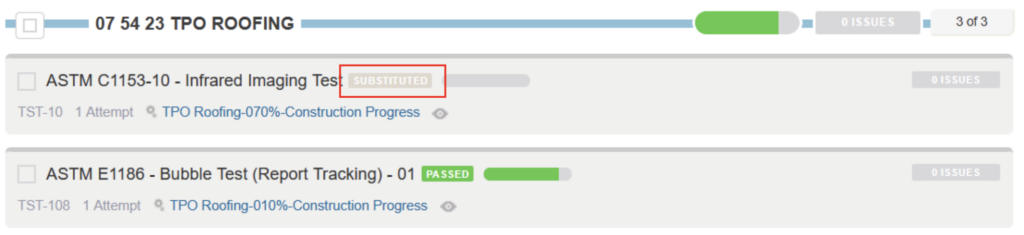
- Status tags. A status tag marks a test that has been omitted or removed from scope during construction. In one example, an infrared imaging test on TPO roofing at 70 percent is tagged as substituted.
- Progress by division. Tests sorted by equipment type, with an overall progress bar, give a high-level view of remaining test fulfillment for each division.
- Mobile verification. Using the mobile interface, the BECxP can verify on site in real time. Field engineers can reference earlier attempts, diagnose what is happening, and file photos against the line where a failure occurred.
Meetings
Meeting minutes capture team discussions, assign action items, and document key decisions. Baumann has found standalone BECx meetings more effective than adding enclosure items to the end of an OAC (owner, architect, contractor) meeting, where most attendees are not part of that scope. Baumann owns the meeting invite and keeps the conversation focused, typically under 45 minutes.
Field observation reports
Field observation reports document construction progress and issues identified during site visits. Wagner called them invaluable. When an observation needs discussion, the team can pull up the associated image directly in the meeting.
Issues
Issues observed on site visits, in tests, or in checklists during construction are tracked as Construction Issues. Like Design Issues, they are assigned to specific team members by priority and linked to the exact referenced detail. Because issues are associated with a range of core objects, they help hold each member of the project team accountable.
Teamwork
General contractors, subcontractors, the architect of record, and ownership can all be brought into the workflow. Each stakeholder has a role, sees the information relevant to that role, provides updates, tracks assigned tasks and project progress, and can be notified digitally when statuses change.
What changes
In Baumann’s experience, the digital approach improves accountability across the project team, the documentation of the BECx process, and the delivery of high-performance building outcomes.
- Contractors can plan for testing. When contractors are invited in, they can add testing and verification requirements and timeframes to their own critical path.
- Teams see status in real time. Project teams have a live dashboard of every piece of equipment in BECx scope.
- Delivery scales. Digital information management improves efficiency, transparency, and scalability. Baumann can scale its resources to deliver anything from a light scope to a full ASTM E2947 engagement cost-competitively.
Two projects from the field
Both case studies are Baumann Consulting BECx projects managed in CxAlloy. The counts cover the BECx scope only.
| Bartillon Men’s Homeless Shelter | Consumers Energy Kalamazoo Service Center Renovation | |
|---|---|---|
| Location | Madison, WI | Kalamazoo, MI |
| Gross floor area | 51,575 SF | 146,810 SF |
| Certification | LEED v4 | LEED |
| Timeline | July 2024 to February 2026 | August 2023 to March 2026 |
| Checklists tracked | 32 | 17 |
| Tests tracked | 48 | 14 |
| Meetings | 12 | 11 |
| Field observation reports | 7 | 5 |
Bartillon Men’s Homeless Shelter, Madison, Wisconsin
On this cross-laminated timber project, the City of Madison, general contractor Miron Construction, and its subcontractors integrated closely into the BECx process through CxAlloy. All 12 meetings were dedicated BECx meetings.
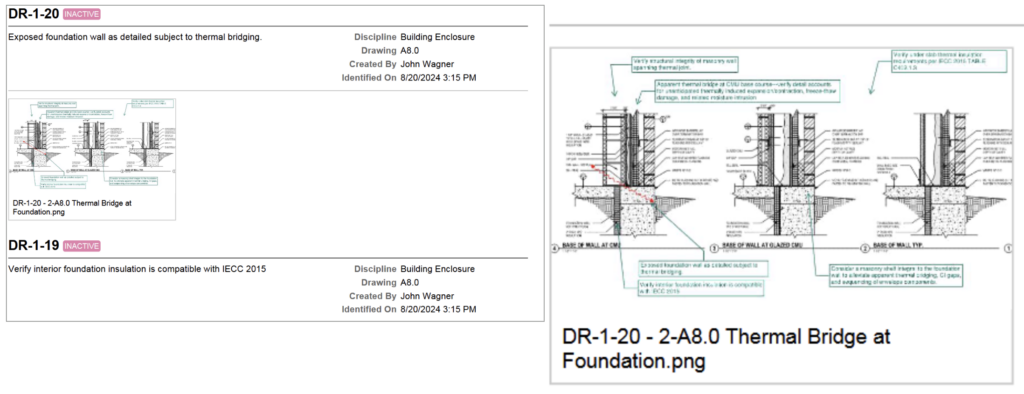
Design review paid off in the field. Baumann’s design review surfaced issues early in the design phase. Its comments included a thermal bridge at the exposed foundation wall and interrupted continuous insulation at openings and masonry shelves, with a recommendation to use thermally broken masonry shelf supports. During field testing, the team could then show the client problems inherent to the design, which Wagner framed as points for future projects to reconsider.
Self-performed testing, tracked the same way. At the owner’s request, Baumann performed the field test verification itself. The team used CxAlloy to build pack-in and pack-out checklists so engineers could arrive on site, set up their kit, and perform the tests, and used the same test records it would use to track a third party’s testing. When other third parties performed whole-building blower door testing, Baumann tracked it with the same test entity.
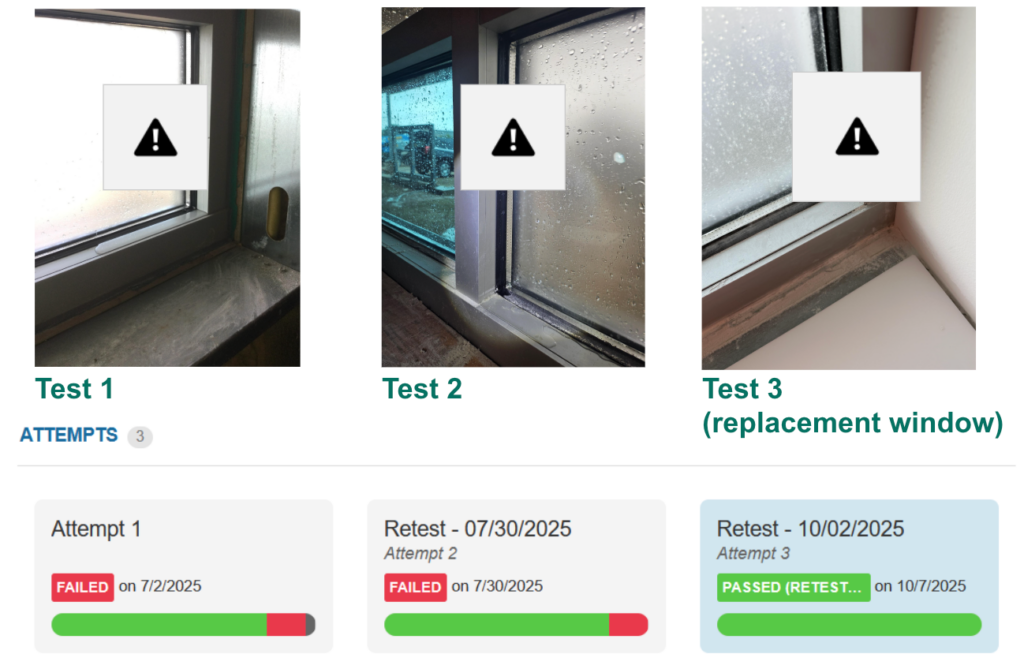
Scope can grow fast. Three attempts were run at the same storefront window location on a Baumann-performed AAMA 503 field test, between summer and fall 2025. The first failed within 30 seconds and the second within a minute and 30 seconds. The subcontractor concluded there was a shop deficiency, replaced the entire window, and it passed on the third test. Wagner’s point: enclosure work carries an inherent scope creep, adding touch points that are not in the contract unless you anticipate them.
Consumers Energy Kalamazoo Service Center Renovation, Kalamazoo, Michigan
This project renovated an existing maintenance facility for Consumers Energy crews as an adaptive reuse. The MEP commissioning ran in parallel in the same CxAlloy project, with many more tests, meetings, and field observations than the BECx figures above.
Contractor-driven checklists. General contractor The Christman Company fully integrated into CxAlloy and had each subcontractor complete checklists on a routine schedule, with time allocated in its Gantt chart for a subcontractor to finish a checklist before installing a window. The contractor fulfilled all pre-construction checklist requirements, and subcontractors completed the construction checklists in the field.
Problems caught early. With 117 punched openings on the project, the checklists let the team spot problems within the first three windows installed. Per Wagner, that early catch saved the owner considerable cost.

Issues closed out and documented. Baumann tracked and verified test fulfillment, and issues identified in testing were addressed, closed out, and documented. One high-priority construction issue, raised from a field observation, flagged a risk of water intrusion beneath a window sill frame as the waterproof membrane was detailed. The owner, architect, contractor, and Baumann reviewed the detail, and it was closed through an RFI with revised details.
Where BECx is heading
Wagner sees building enclosure commissioning gaining momentum across US jurisdictions, and two references stand out in his account:
- ASHRAE Standard 90.1. As adopted by most states, it now requires air barrier verification as a minimum where whole-building blower door testing is not performed. Baumann would define that as a light BECx scope.
- LEED v5. Minimum building enclosure commissioning requirements, previously associated with the Enhanced Commissioning credit, move into the Fundamental Commissioning prerequisite under Energy and Atmosphere. For MEP commissioning teams on LEED projects, that means bringing in enclosure expertise, whether through a joint venture or an associate on the team.
The reference documents the presenters pointed to span NIBS Guideline 3-2012, ASTM E2813-18 (Standard Practice for Building Enclosure Commissioning), ASTM E2947-16a (Standard Guide for Building Enclosure Commissioning), ASHRAE Guideline 0-2005, ANSI/ASHRAE/IES Standard 90.1-2022, and the LEED v5 reference guide for building design and construction.
As requirements grow, so does the case for bringing the trades into the commissioning platform. Having contractors upload their own work from the start reduces double work, because no one has to transcribe their notes. Baumann’s pitch to contractors has shifted too. It used to be that the platform made their work easier. Now it is that the platform helps them stay ready for state requirements and municipal energy standards. In Wagner’s experience, the harder hurdle can be a contractor’s unfamiliarity with BECx itself, rather than with the software.
Wagner also sees a real advantage when the contractor’s critical path schedule management is integrated with a commissioning platform, so every party works from a dynamic, up-to-date dashboard.
Takeaways
- Structure strengthens delivery. Structured digital workflows strengthen BECx by organizing assets, construction phases, and testing activities in a single system, with submittal requirements tracked alongside them.
- Digital beats spreadsheets. Digital information management improves efficiency, transparency, and scalability, from a light BECx scope on a utility shed to the far more rigorous requirements of a critical facility like a hospital.
- Bring contractors in early. Involving contractors in the project setup during procurement and the first months of mobilization improves accountability and coordination and reduces field errors and rework. Their participation decides whether you can stay aware of day-to-day changes.
BECx directly links ownership to the trades in the field. It is the trades’ workmanship and material knowledge of how assemblies go together that can prevent the most consequential building performance problems. A structured digital workflow gives that interaction a clear structure and gives every trade a way to contribute to the outcome.
About the presenters. John David Wagner, AIA, BECxP, CxA+BE, is a Senior Building Enclosure Consultant and leads the Building Enclosure Performance team at Baumann Consulting. Jacob Terry is Director of Product Development at CxAlloy and has worked on the platform for nearly two decades.
See it on your own projects. Whether you run a light code-compliance scope or a full ASTM E2947 engagement, CxAlloy gives your team one place to track enclosure assets, checklists, tests, and issues from mock-up to 100 percent. Request a demo or start a free trial.